
Excellence in Aquariuz laser system applicationfor refractive surgery - engineering analysis
Quick answers
What is AQUARIUZ?
AQUARIUZ is a solid-state UV laser system developed for refractive surgery. The system operates at 205–215 nm and uses advanced eye-tracking technology to precisely deliver laser pulses.
How does AQUARIUZ differ from traditional excimer lasers?
Unlike conventional ArF excimer lasers, which use a gas mixture to generate 193 nm UV radiation, AQUARIUZ is a solid-state laser system that operates at longer UV wavelengths.
Why is laser energy important in refractive surgery?
The amount of laser energy delivered largely determines how much corneal tissue is removed. Stable and precise energy delivery is therefore essential to ensure that the actual ablation corresponds to the programmed treatment.
What is the thesis project investigating?
The project investigates the relationship between the laser’s energy parameters, treatment data, and clinical outcomes. Among other things, it analyzes energy stability, treatment precision, changes in corneal geometry, and optical quality following treatment.
What clinical data are included in the analysis?
The dataset includes, among other things, refraction, visual acuity, corneal curvature, pachymetry, and wavefront aberrations. These measurements make it possible to correlate the laser treatment with subsequent changes in the cornea and the optical quality of vision.
What can the project contribute?
The project may provide a more quantitative understanding of how the stability and precision of laser energy affect the actual treatment. In the long term, the results may contribute to improved monitoring, calibration, and optimization of UV laser treatments in refractive surgery.
The accuracy of laser refractive surgery depends on the ability to translate a target optical correction into a precisely controlled modification of the corneal profile. This requires accurate spatial delivery of laser pulses and, critically, stable control of the optical energy delivered to the tissue.
A Master’s thesis project at Copenhagen Eye Institute, in collaboration with the Technical University of Denmark (DTU), will investigate the performance of the AQUARIUZ solid-state UV laser system, with particular focus on laser energy, treatment parameters and their relationship to measured clinical outcomes.
The project is carried out by MSc Biomedical Engineering student Fanny Boldrin under the supervision of Dr. Javier Cabrerizo at Copenhagen Eye Institute, Associate Professor Torben Anker Lenau at DTU Construct – Department of Civil and Mechanical Engineering, and Senior Researcher Ole Bjarlin Jensen at DTU Electro – Department of Electrical and Photonics Engineering.
Solid-state UV laser ablation
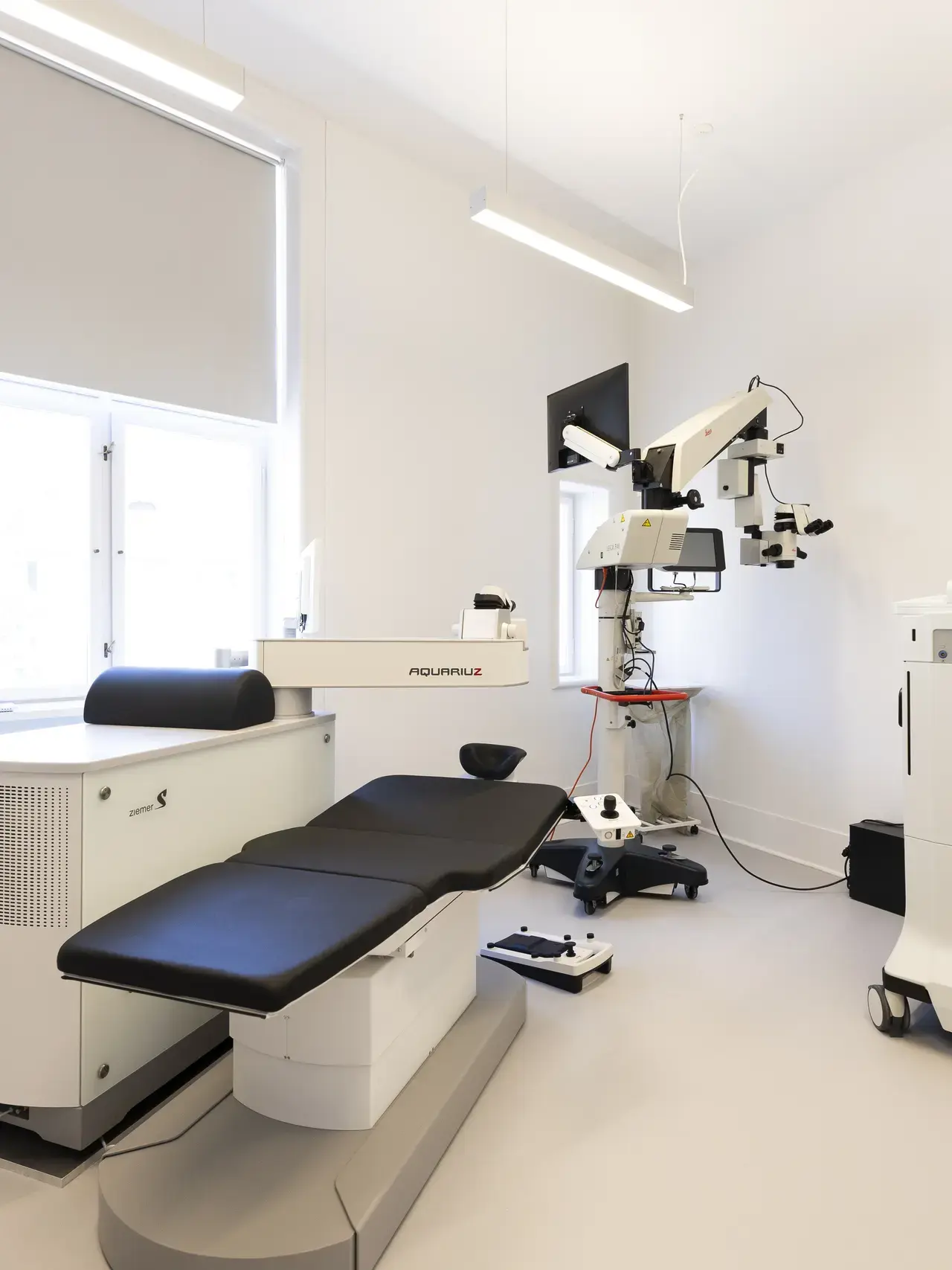
AQUARIUZ, developed by Ziemer Ophthalmic Systems, differs from conventional ArF excimer systems used for corneal photoablation. Instead of generating 193 nm radiation from an excimer gas mixture, AQUARIUZ is a solid-state laser platform operating at 205–215 nm, with a repetition rate of up to 500 Hz.
Laser delivery is controlled by a six-dimensional eye-tracking system operating at 1000 Hz, allowing the ablation pattern to adapt continuously to ocular motion during treatment.
At these wavelengths, the water absorption coefficient is significantly lower than at 193 nm, while absorption by the organic components of the corneal stroma remains significant, allowing the stromal surface to remain hydrated during treatment and enabling the wet-ablation principle used by AQUARIUZ.
The resulting tissue ablation does not depend solely on wavelength, but on the optical energy delivered by the system. The relationship between fluence and tissue removal is therefore a key aspect of treatment performance.
Variations in pulse energy, beam area or spatial pulse distribution can modify the local optical dose and potentially produce differences between the programmed and achieved ablation profiles.
This provides two main advantages form previous excimer lasers, higer precision and less inflammatory response. Those two concepts put this technology of the forefront of vision laser correction.
From laser energy to clinical outcomes
A central part of the project will be the quantitative investigation of laser energy levels and energy stability during clinical treatments.
The exact laser parameters available for analysis will depend on access to the system data, but potentially relevant variables include pulse energy, pulse-to-pulse energy variation, pulse duration, repetition rate, spot size and spatial beam profile.
Treatment information such as the number and spatial distribution of delivered pulses, programmed ablation depth and optical zone may additionally be available.
These engineering parameters will be combined with a longitudinal clinical dataset containing preoperative and postoperative measurements.
The available data include sphere, cylinder and axis, uncorrected and corrected distance visual acuity (UDVA and CDVA), corneal keratometry, pachymetry and wavefront aberrations over a 6 mm analysis diameter.
The latter include RMS low- and higher-order aberrations as well as spherical aberration, astigmatism, defocus, coma, trefoil and quatrefoil components.
This enables the complete treatment pathway to be investigated, linking the delivered laser energy to corneal tissue ablation, the resulting changes in corneal geometry, and their effect on the final optical outcome.
Changes in pachymetry and corneal curvature can provide quantitative indicators of the physical modification of the cornea, while postoperative refraction and wavefront aberrations describe the resulting optical performance.
Comparing these variables with treatment and laser parameters may reveal whether variations in delivered energy are associated with differences in achieved refractive correction or optical quality.
Computational analysis in Python and/or MATLAB will be used to quantify system behaviour, identify correlations and develop statistical or analytical models linking laser parameters with measured outcomes.
Particular attention will be given to energy stability, treatment precision and systematic sources of variation. Where sufficient laser data are available, the analysis may also investigate energy-to-tissue-removal relationships and compare programmed versus measured treatment effects.
An Overview of Laser Treatment
By combining laser physics, engineering data and longitudinal clinical measurements, the project aims to establish a quantitative understanding of how consistently the AQUARIUZ platform converts controlled UV energy delivery into the intended corneal and refractive changes.
The results may ultimately contribute to improved performance monitoring, calibration and optimization of solid-state UV laser treatments in refractive surgery.