
Keratoconus Treatment
Read about keratoconus treatment and price at the Copenhagen Eye Institute eye clinic.
Keratoconus Treatment
The treatment strengthens the cornea’s structure using ultraviolet light and riboflavin, which can slow the progression of the disease and preserve vision.
UV Cross-Linking is a safe and well-documented treatment that stops or slows the progression of keratoconus.
What is UV cross-linking
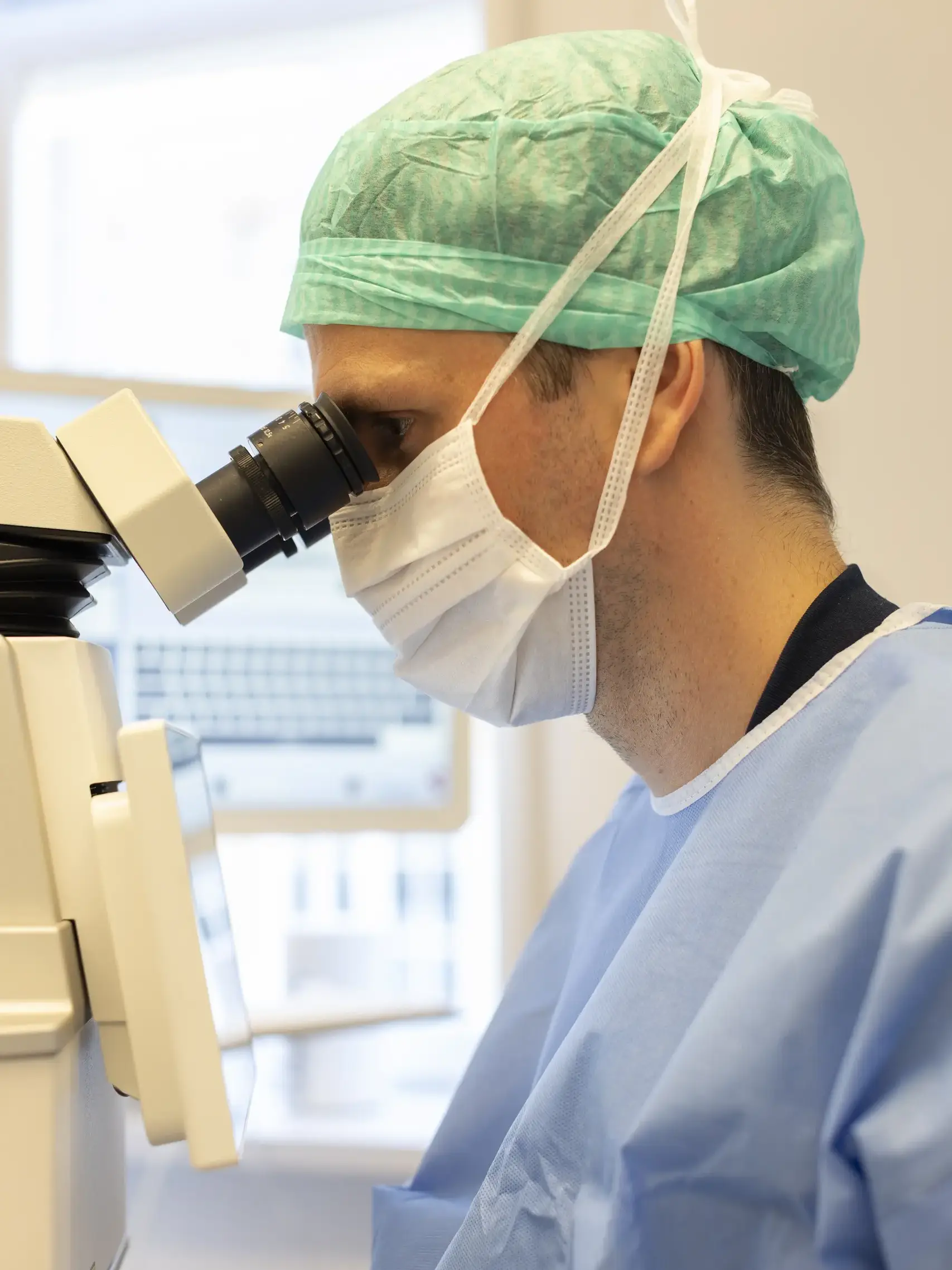
Ultraviolet cross-linking (UV cross-linking) is a treatment that strengthens the cornea by forming chemical bonds between its fibers. The treatment is used for the eye disease keratoconus, where the cornea gradually becomes thinner and more cone-shaped. UV cross-linking can stabilize the disease in 90% of cases and prevent further deterioration without necessarily improving vision.
The purpose of Keratoconus treatment
In keratoconus, the shape of the cornea can change, distorting vision. UV cross-linking slows this development so that vision is not further impaired. It is a preventive treatment and the effect usually lasts for many years. In rare cases (around 2%), complications such as corneal clouding may occur.
Before treatment
- Do not take a break from blood thinners.
- If you are nervous, you can get a calming tablet on arrival.
How does UV cross-linking work?
The treatment takes approximately 2 hours and takes place under local anesthesia in the operating room:
- Removal of surface cells on the cornea.
- The eye is dripped for 20-30 minutes.
- The cornea is illuminated with ultraviolet light for 10 minutes, which activates the cross-linking and strengthens the cornea.
- You’ll receive a drop that dilates the pupil and relieves pain for up to 4-5 days.
- An eye patch is applied after the treatment.
After UV cross-linking
Eye patch:
- Keep on for the rest of the day to protect against further UV light.
Eye drops:
- 4 times daily until your checkup (within 14 days).
- The prescription is issued on the day of surgery.
Pain and relief:
- Light to moderate pain is normal for the first few days.
- Paracetamol 500 mg can be used as needed.
- Eye drops can be used for pain relief (at most every 15 minutes and only for the first 3 days).
What can you do after treatment?
- You can take a shower.
- You may resume physical work after a few days.
- Avoid dirt in the eye for the first week.
- No sea bath, swimming pool or swimming pool.
- No makeup before check-ups.
- Contact lens use should only be resumed after approximately 1 month.
Vision After the Treatment:
- Vision is often blurred in the first few days.
- The blur gradually improves, but slight blurring may continue for 3-6 months.
Sick Leave:
You can usually return to work after 3–4 days, depending on the nature of your job.
Possible Complications:
UV cross-linking is a safe treatment, but the following may occur:
- Corneal inflammation
- Slow healing of the surface wound
Contact the eye department if:
- Persistent or increasing pain
- Increased redness in the eye
- Pus formation
- Deterioration of vision
- Other unexpected symptoms
PRICES & PAYMENT
The price includes a personalized treatment plan, surgery, all follow-up visits, and a lifetime treatment guarantee.
HEALTH INSURANCE
Most private health insurance providers in Denmark offer coverage or partial reimbursement for eye specialist consultations and treatments as part of their health plans. It is important that you contact your insurance company before your visit to confirm that they cover the service.
INSTALLMENT PAYMENTS
With a Health+ Credit, you can split the payment of your treatment into smaller, manageable installments without any hassle.
THIS IS WHAT OUR PATIENTS SAY
Fanny27 september 2026 I had a really positive experience at the clinic: the staff is incredibly nice and makes you immediately feel comfortable, while being very professional and efficient. The clinic is modern and well organized, with a relaxed vibe that matches the elegant aesthetic. Truly recommend if you want to mix high quality service and a welcoming atmosphere!Martin24 september 2026Thoroughly knowledgeable people. It's nice when the people who will operate on you eyeballs know what they are doing. On top, I've been treated with kindness.Mette17 september 2026God opfølgning og forklaring. Hjælper mig med en second opinion.Tiana15 september 2026Dr. Javier Cabrerizo and his team provided me with the best medical care of any kind that I have experienced since moving to Copenhagen. Nurse Jutta Tuisku-Salo guided me through each of the necessary examinations with great care and professionalism, while Kari Postma made the billing process fast and easy. Dr. Cabrerizo is highly skilled, compassionate, and dedicated to his patients and his craft. I am most grateful to have him as my ophthalmologist and feel fortunate to have received care from such an outstanding team. Anyone in Copenhagen or beyond who needs expert eye care would be very well served by the Copenhagen Eye Institute. I highly recommend Dr. Cabrerizo and his entire team.Birte11 august 2026Venlig og lyttende kommunikation Hurtig og effektiv afvikling af undersøgelseShirley6 august 2026Beautiful rooms, excellent service and really warm, professional staff. Successful cataract operation ... quick, painless, excellent results! Highly recommended.Oliver6 august 2026Rendez vous obtenu tres rapidement. Equipe tres professionnelle et a l'écoute.
For us, it is not only about your vision, but about creating a sense of security, trust, and an experience where you feel seen and valued from start to finish.
CERTIFICATIONS
Copenhagen Eye Institute is a specialized eye clinic focusing on eye diseases and eye surgery. We are certified to perform both clinical treatments and advanced surgical procedures.
PATIENT STORY
Find out how lens surgery improved our patient’s quality of life. Glasses and contact lenses were a challenge for his daily activities, but after the eye surgery, he can now play padel and watch TV completely without glasses and contact lenses.
SEE ALSO
That’s how easy it is to get started at Copenhagen Eye Institute
Questions regarding keratoconus UV cross-linking
Does UV cross-linking solve keratoconus?
UV cross-linking cannot cure keratoconus, but it can slow the progression of the disease and improve vision. The treatment strengthens the structure of the cornea by “cross-linking” collagen fibers with UV light and a special drop, which can prevent further deterioration of the disease.
How do you treat keratoconus with UV light?
The treatment of keratoconus with UV light, called UV cross-linking, involves applying a special liquid (riboflavin) to the cornea, which is then exposed to UV light. The UV light activates the riboflavin and strengthens collagen fibers in the cornea, making it more stable and preventing the disease from worsening. The treatment can also help improve vision.
What is UV cross-linking?
UV cross-linking is a treatment for keratoconus in which the corneal structure is strengthened using UV light and riboflavin drops. The UV light activates riboflavin, which “binds” collagen fibers together, increasing corneal stability and slowing the progression of the disease. The treatment can improve vision and prevent further deterioration.

Take the first step: Book an eye specialist consultation
Are you wondering if keratoconus treatment is right for you? Let us examine your eyes and give you a professional answer. At the Copenhagen Eye Institute in Copenhagen K, we have short wait times, and you can often get an appointment with an ophthalmologist as early as the same week.

Eye doctor in Copenhagen K
Copenhagen Eye Institute is an eye clinic in Copenhagen with short waiting times and specialized treatment.