
Cataract surgery in Copenhagen -
regain clear vision with a modern lens surgery
A cataract surgery is a safe and effective procedure where the eye’s cloudy natural lens is replaced with a clear artificial lens.
The surgery is performed under local anesthesia with eye drops, typically takes 15-20 minutes per eye, and most people experience significantly better vision as early as the next day.
In short: Cataract surgery
What is cataract?
A clouding in the eye's natural lens
How is it treated?
The cloudy lens is removed and replaced with an artificial lens
How long does the procedure take?
About 15–20 minutes
Are you awake?
Yes, the operation is carried out under local anaesthetic
Is it painful?
No, most people do not experience pain
When can you see better?
Many people notice an improvement as early as the following day
PLUS LENSES
Replacing your lenses with plus lenses corrects your vision at a single distance
- Single-vision freedom from glasses
- Treatment tailored to your lifestyle
- Post-operative check-ups
- Reassuring support throughout the entire journey
- Fast outpatient treatment
- Painless surgery under local anesthesia
- Modern Zeiss technology
Plus lens types:
- Monofocal Lens
- Monofocal Plus Lens
PREMIUM LENSES
Replacing your lenses with premium lenses corrects your vision at multiple distances
- Multi-distance freedom from glasses
- The possibility of clear vision at multiple distances without glasses
- Treatment tailored to your lifestyle
- Post-operative check-ups
- Reassuring support throughout the entire journey
- Fast outpatient treatment
- Painless surgery under local anesthesia
- Modern Zeiss technology
Premium lens types:
- EDOF Lens
- Multifocal Lens
What is cataract, and what are its symptoms?

Cataract simply means that the eye’s natural clear lens gradually becomes cloudy over time. The lens acts as the eye’s window, and when it slowly becomes misted, light can no longer pass through clearly and precisely to the retina. Cataracts usually develop slowly over several years and often affect both eyes—though rarely at the same pace. The condition cannot be corrected with new glasses or contact lenses alone; the only effective treatment is a quick and gentle lens replacement.
Cataract surgery is one of the most commonly performed and safest surgical procedures in the world.
Watch for the signs: Typical symptoms of cataract
Cataracts develop gradually, and many people unconsciously adapt to worsening vision before they realise how much it is actually limiting them. Watch for these classic warning signs in everyday life:
- Cloudy or blurred vision: The world looks as if you are looking through a light haze or a dirty window.
- Severe glare: Sunlight, bright lamps, or oncoming headlights at night create uncomfortable halos and reduce your ability to see clearly.
- Dull or yellowish colours: Contrast fades, and white surfaces may suddenly appear yellowish or greyish.
- Feeling unsafe in traffic: It becomes harder to quickly orient yourself while driving, especially at dusk.
- Constant prescription changes: You need to change your glasses frequently without any real improvement in vision.

Risk factors that can accelerate development.
Although cataracts are primarily caused by normal biological ageing, there are several lifestyle and health-related factors that can cause the condition to develop more quickly or at an earlier age:
- Diabetes (diabetes mellitus): High blood sugar levels can accelerate clouding of the lens.
- Medical treatment: Long-term use of corticosteroids (steroids) – even in low doses.
- Previous eye injuries: A blow, trauma, or prior inflammation in the eye (e.g., uveitis/iritis).
- UV radiation: Long-term, unprotected exposure to strong sunlight without sunglasses.
- Lifestyle and treatments: Smoking as well as certain types of cancer treatment (including radiation therapy).
When should you have cataract surgery?

Cataract surgery is usually recommended when your vision is affecting your quality of life.
It’s not just about your eyesight on a chart, but about how you cope in everyday life.
Typical signs that the time may have come:
- you’ll be dazzled by car headlights
- you find it difficult to read
- the colours look dull
- you feel unsure when out and about
- new glasses no longer help
Not sure if you’re a good candidate? Book a free preliminary assessment and get a professional evaluation.
How the procedure works – step by step
1. Anaesthesia
The eye is numbed using local anaesthetic eye drops.
2. Removal of the cloudy lens
The surgeon makes a microscopic incision and removes the cloudy lens
3. Implantation of an artificial lens
A new artificial lens is permanently implanted in the eye.
4. Home on the same day
There are usually no stitches, and you can go home shortly after the operation.
What you should avoid during the healing period
To give your eye the absolute best conditions for fast and optimal healing, you should follow these simple precautions after the procedure:
- First 7 days: Avoid rubbing your eyes, avoid getting water directly into your eyes (be careful in the shower), pause strenuous physical activity, and avoid eye makeup and eye creams.
- First 14 days: Completely avoid swimming pools, hot tubs, saunas, as well as swimming in the sea or lakes.
- First 4 weeks: Avoid sports with a risk of close contact or impact, eyelash tinting, as well as diving or water sports.
PRICES & PAYMENT
plus contact lenses
PRISThe price includes a preliminary examination, an individualized treatment plan, surgery, all follow-up visits, and a lifetime treatment guarantee.
premium lenses
PRISThe price includes a preliminary examination, an individualized treatment plan, surgery, all follow-up visits, and a lifetime treatment guarantee.
HEALTH INSURANCE
Most private health insurance providers in Denmark offer coverage or partial reimbursement for eye specialist consultations and treatments as part of their health plans. It is important that you contact your insurance company before your visit to confirm that they cover the service.
INSTALLMENT PAYMENTS
With a Health+ Credit, you can split the payment of your treatment into smaller, manageable installments without any hassle.
Results and Risks

Cataract surgery is one of the most commonly performed and safest procedures in the world. As with all surgical procedures, however, there is a small risk of complications, such as a temporary increase in intraocular pressure, retinal detachment, or, in very rare cases, infection. At the Copenhagen Eye Institute, we minimize these risks through extreme sterility, state-of-the-art surgical techniques, and close follow-up care.

TREATMENT GUARANTEE
Necessary check-ups and any required fine-tuning are included at no extra cost. If hospital treatment is needed, we will arrange a referral and follow-up examination with an ophthalmologist.
Book a free preliminary assessment, and we’ll evaluate your specific risk profile.
Meet your eye doctor

Your safety is built on our experience. At Copenhagen Eye Institute, we place great emphasis on ensuring that you are always treated by top eye surgery specialists.
Our eye surgeon is Dr. Javier Cabrerizo, an ophthalmologist with many thousands of successful complex surgeries to his credit. He stays constantly up to date on the latest international research and professional literature in the field of refractive surgery, which is your guarantee of top-notch professional expertise.
For us, treatment does not end when the laser is switched off. The follow-up programme is an integral and essential part of our premium concept. We regularly monitor your eyes as they heal and are always available to answer your questions, so you can feel 100% confident throughout your journey towards your new vision.
Book a free preliminary assessment, and we’ll evaluate your specific risk profile.
THIS IS WHAT OUR PATIENTS SAY
Fanny27 september 2026 I had a really positive experience at the clinic: the staff is incredibly nice and makes you immediately feel comfortable, while being very professional and efficient. The clinic is modern and well organized, with a relaxed vibe that matches the elegant aesthetic. Truly recommend if you want to mix high quality service and a welcoming atmosphere!Martin24 september 2026Thoroughly knowledgeable people. It's nice when the people who will operate on you eyeballs know what they are doing. On top, I've been treated with kindness.Mette17 september 2026God opfølgning og forklaring. Hjælper mig med en second opinion.Tiana15 september 2026Dr. Javier Cabrerizo and his team provided me with the best medical care of any kind that I have experienced since moving to Copenhagen. Nurse Jutta Tuisku-Salo guided me through each of the necessary examinations with great care and professionalism, while Kari Postma made the billing process fast and easy. Dr. Cabrerizo is highly skilled, compassionate, and dedicated to his patients and his craft. I am most grateful to have him as my ophthalmologist and feel fortunate to have received care from such an outstanding team. Anyone in Copenhagen or beyond who needs expert eye care would be very well served by the Copenhagen Eye Institute. I highly recommend Dr. Cabrerizo and his entire team.Birte11 august 2026Venlig og lyttende kommunikation Hurtig og effektiv afvikling af undersøgelseShirley6 august 2026Beautiful rooms, excellent service and really warm, professional staff. Successful cataract operation ... quick, painless, excellent results! Highly recommended.Oliver6 august 2026Rendez vous obtenu tres rapidement. Equipe tres professionnelle et a l'écoute.
For us, it is not only about your vision, but about creating a sense of security, trust, and an experience where you feel seen and valued from start to finish.
CERTIFICATIONS
Copenhagen Eye Institute is a specialized eye clinic focusing on eye diseases and eye surgery. We are certified to perform both clinical treatments and advanced surgical procedures.
PATIENT STORY
Find out how lens surgery improved our patient’s quality of life. Glasses and contact lenses were a challenge for his daily activities, but after the eye surgery, he can now play padel and watch TV completely without glasses and contact lenses.
Advanced technology for precise cataract surgery
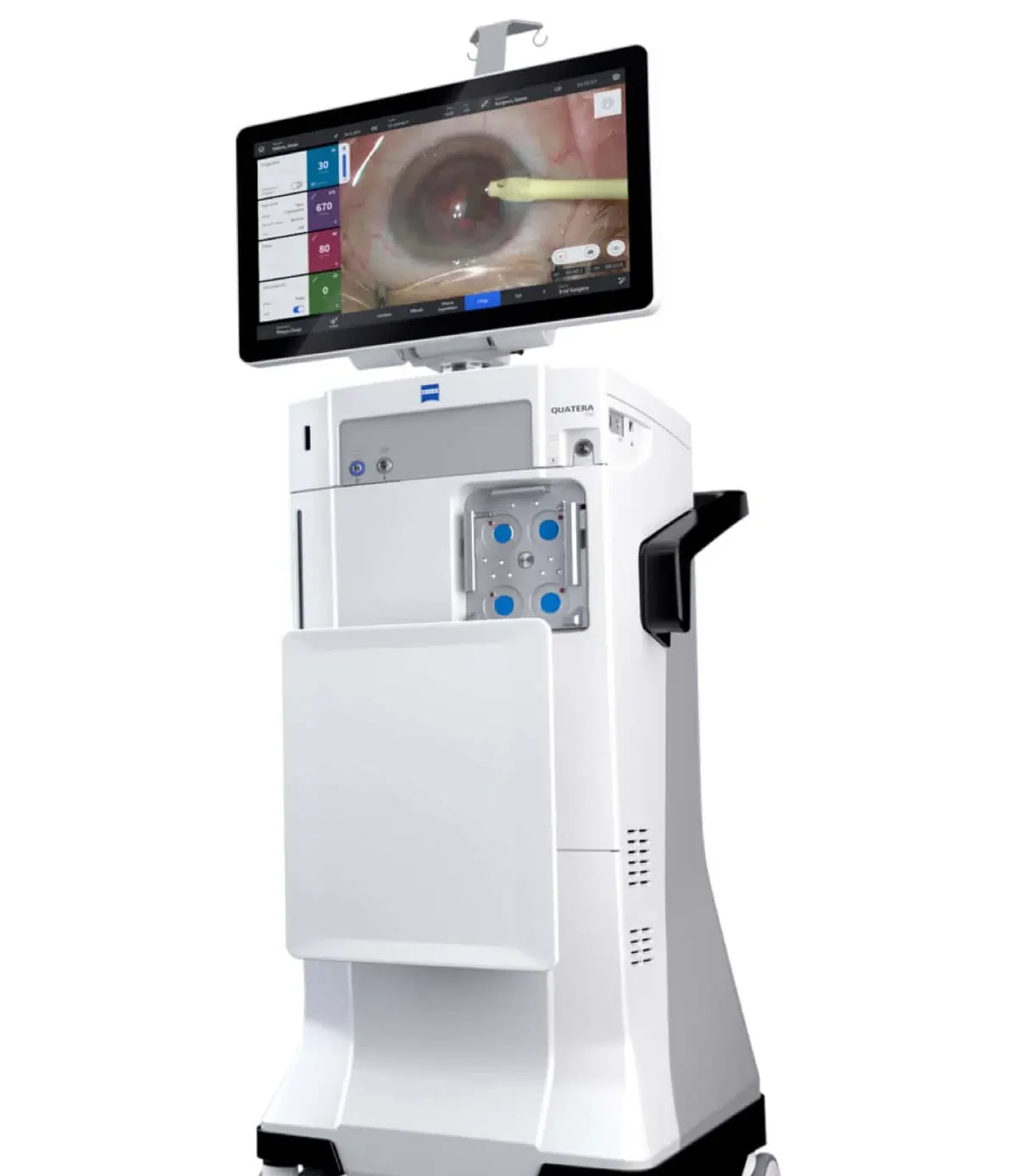
At the Copenhagen Eye Institute, we use the Zeiss Quatera 700, an advanced system for modern lens surgery.
Advantages:
- precise control during the operation
- gentle treatment
- Optimal positioning of the artificial lens
Can you stop wearing glasses after cataract surgery?

Yes, in many cases, choosing the right contact lens can reduce the need for glasses.
With monofocal lenses, many people achieve clear vision at a single distance.
With premium lenses such as EDOF or multifocal lenses, some patients can achieve functional vision at several distances.
The right choice depends on:
- your lifestyle
- your vision requirements
- your expectations
What is the difference between cataract surgery and lens replacement?
Cataract surgery
Purpose
Treating a cloudy lens
Typical patient
Has a cataract
Natural lens
Uklar
Artificial lens
Yes
Surgery
The same technique
Lens exchange
Purpose
Reducing the need for glasses
Typical patient
Often suffers from age-related vision problems
Natural lens
Usually clear
Artificial lens
Yes
Surgery
The same technique
SEE ALSO
That’s how easy it is to get started at Copenhagen Eye Institute
FREQUENTLY ASKED QUESTIONS
What is cataract?
Cataracts are a condition in which the eye’s natural lens becomes cloudy. This causes blurred vision, glare, and reduced contrast, which cannot be corrected with glasses or contact lenses.
When should I consider cataract surgery?
Surgery is recommended when vision begins to affect your daily life—for example, when driving, reading, working at a computer, or navigating in low light.
How is Cataract Surgery Performed?
The procedure is performed under local anesthesia with eye drops and typically takes 15–20 minutes per eye. The cloudy lens is removed and replaced with an artificial lens tailored to your vision and needs. You can go home the same day.
Which types of lenses can I choose?
You can choose between standard lenses (monofocal and monofocal plus) or premium lenses (EDOF and multifocal). The choice depends on whether you want clear vision at one or multiple distances—and how independent from glasses you wish to be.
How quickly will my vision return after surgery?
Most patients experience improved vision as early as the day after surgery. Vision typically stabilizes over 2–6 weeks, depending on the lens type and individual healing.
Is cataract surgery safe?
Yes. Cataract surgery is one of the safest and most commonly performed surgeries in the world. At Copenhagen Eye Institute, we use advanced technology that enhances precision, safety, and faster healing.
Can I be free of glasses after surgery?
Many patients can reduce or completely eliminate the need for glasses—especially with premium lenses. With standard lenses, reading glasses may still be needed, depending on which distance is corrected.
How long does an artificial lens last?
The artificial lens lasts a lifetime. Cataracts do not return.
How long does cataract surgery take?
Approx. 15–20 minutes per eye.
When can I drive after cataract surgery?
This is assessed on a case-by-case basis, but many people are able to resume driving after a check-up and once the vision requirements have been met.
Can a cataract come back?
No, but some people may later develop cataracts, which can be easily treated with a laser.
What should you avoid doing after the operation?
You should avoid rubbing your eye and avoid swimming, dirt and strenuous physical activity during the initial period.

Take the first step: Book an eye specialist consultation
Are you considering whether cataract treatment is right for you? Let us examine your eyes and provide a professional assessment. At Copenhagen Eye Institute in central Copenhagen (København K), we have short waiting times, and you can often get an appointment with an eye specialist within the same week.
Book a free preliminary assessment, and we’ll evaluate your specific risk profile.

Eye doctor in Copenhagen K
Copenhagen Eye Institute is an eye clinic in Copenhagen with short waiting times and specialized treatment.