Why it is important to choose an eye doctor if you are considering laser eye surgery or lens surgery
Quick answers
Who should assess whether you are a suitable candidate for vision-correcting surgery?
An eye doctor/ophthalmologist with experience in refractive surgery should assess whether laser eye surgery, lens replacement (RLE) or another treatment is the best option. This assessment is based on a comprehensive analysis of the eye’s anatomy, visual impairment and individual needs.
What is the difference between an ophthalmologist and an optometrist?
An ophthalmologist is a doctor who has undergone specialist training in eye diseases and eye surgery. An optometrist is trained to examine eyesight, measure lens prescriptions and identify eye problems, but does not perform eye surgery.
Why is it important for the surgeon to carry out the preliminary examination?
When the same ophthalmologist is responsible for the initial examination, the operation and the follow-up appointments, this ensures a consistent assessment and course of treatment. This allows for personalised treatment options and a swift response should any questions or complications arise.
Which vision correction treatments are available?
Depending on the condition of the eye, treatment may include laser eye surgery, lens replacement (RLE), ICL lenses or other refractive solutions. The best treatment depends on the individual patient’s eyes and visual needs.
Can anyone have laser eye surgery?
No. Not everyone is a suitable candidate. A thorough eye examination by an ophthalmologist will determine whether laser treatment is the right option, or whether another form of vision correction would provide a better and safer result.
Why do patients choose Copenhagen Eye Institute?
At the Copenhagen Eye Institute, patients are assessed, operated on and monitored by the same ophthalmologist throughout their entire course of treatment. This ensures continuity, a high standard of care and a personalised assessment of the best vision-correcting treatment.
Choosing to have your eyesight corrected through either laser surgery or refractive lens exchange (RLE) is one of the most important medical decisions you will ever make. The outcome will affect how you see the world for the rest of your life. It deserves more than just good technology and a smooth booking process. It deserves a doctor.
At Copenhagen Eye Institute, we have some of the country’s most experienced optometrists, but every single patient who comes through our doors to have their vision corrected is assessed, treated and followed up by their surgeon. This is not something we promote as an added benefit. We regard it as the fundamental standard of responsible care.
This article explains why, and what this means for you in practice.
Not all consultations regarding vision correction are the same
In recent years, the landscape of vision correction has changed. Laser eye surgery and lens procedures have become more widely available, and with this increased availability has come a wider range of providers offering consultations, initial examinations and even post-operative follow-ups.
Given that the procedure under discussion is irreversible, and that both laser corneal surgery and lens replacement are permanent procedures, we believe that our patients deserve direct contact with their surgeon throughout the entire process.
The pre-operative assessment: This is where the right decision is made
The most important part of your journey towards vision correction is not the operation itself. It is the consultation that precedes it and the post-operative care.
A thorough pre-operative assessment for laser surgery or RLE is not simply a matter of measuring your prescription and checking your corneal thickness. It involves collating a large amount of clinical data – topographic maps, pachymetry, axial length, anterior chamber depth, tear film quality, pupillary dynamics, ocular surface health and more – and translating this into an assessment of which procedure is appropriate, which technology is best suited, and whether the surgery should be performed at all.
At Copenhagen Eye Institute, this assessment is carried out and interpreted by a leading surgeon with extensive surgical training and many years’ experience in refractive surgery. The clinical decisions made at this stage – what to treat, how to treat it, and when not to treat – require precisely this level of expertise.
The difference between a patient who is an excellent candidate for Aqua PRK and one who would be better off with RLE, an ICL implant or no surgery at all is not always clear from the raw measurements. This requires clinical assessment. It requires an ophthalmologist.
Get to know your surgeon before the day of your operation
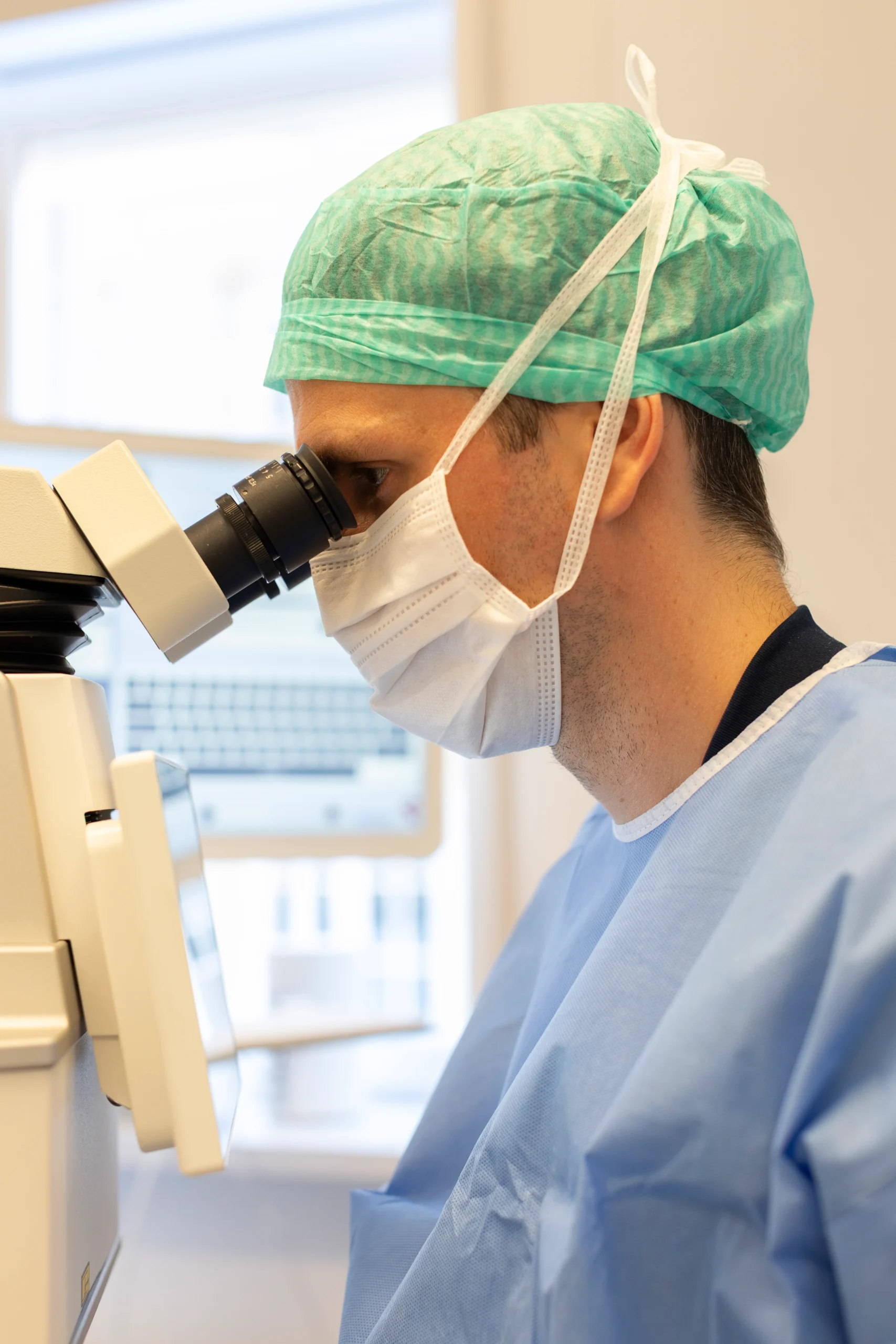
There is a particular sense of reassurance that comes from meeting your surgeon before you go into the operating room.
At Copenhagen Eye Institute, the ophthalmologist who assesses you is the same specialist who will operate on you and look after you afterwards. You will not be sent back and forth between a consultation team and a surgical team. You will not be assessed by one person and treated by another. The clinical pathway is seamless, and this continuity has a direct impact on the quality of your treatment.
Your surgeon is familiar with your corneal topography. Your surgeon remembers the details of your examination. Your surgeon is the person you can call if anything feels different in the days following your operation.
This is important because refractive surgery is not a standardised procedure. Every cornea is different. Every patient’s visual needs and lifestyle are different. The ability to make personalised decisions – before, during and after surgery – depends on a depth of clinical knowledge that can only be built up through ongoing engagement with a patient.
What happens when something unexpected occurs?
The vast majority of vision correction procedures proceed without complications. Modern laser surgery and lens implantation, when performed on carefully selected patients by experienced surgeons, have a very low complication rate. But medicine is not about certainties – it is about probabilities, and there are exceptions. And we never downplay or trivialise a surgical procedure.
A patient may develop unexpected inflammation following lens implantation. Intraocular pressure may rise in the early post-operative period. A patient with a previously undiagnosed tendency towards corneal ectasia may require early intervention. The tear film may react in a way that necessitates a change in treatment.
In each of these scenarios, the question is not simply whether the problem can be identified — it is whether the person identifying it has the necessary training and authority to act on it immediately. An optometrist may detect that something is abnormal. An ophthalmologist can make a diagnosis, prescribe treatment and, if necessary, perform surgery.
When your follow-up care is managed by a doctor – one who is personally familiar with your surgical history and your eyes – there is no delay between recognition and response.
The full range of treatment options, assessed independently
One of the lesser-known benefits of being assessed by a surgeon who performs several types of vision correction procedures is clinical independence.
At Copenhagen Eye Institute, we offer laser surgery, refractive lens replacement, ICL implantation and add-on lenses. As we are not limited to a single procedure or a single technology, our recommendation to you is based solely on what is clinically best for your eyes – not on what is most readily available, most convenient or most commercially straightforward.
These are not simply algorithmic decisions. They are clinical judgements, made by someone who has the necessary training to weigh up all the variables and the integrity to recommend the solution that is right for you – even if it is not the one you originally asked for.

Continuity of care: From the first consultation to the final follow-up
At Copenhagen Eye Institute, the ophthalmologist-led care does not end when you leave the operating room. Your follow-up appointments – after one day, one week, one month and thereafter – take place within a clinical setting where your surgeon remains the clinician in charge throughout the entire process.
This means that the person reviewing your post-operative topography is the same person who assessed your pre-operative maps. The person assessing your refraction after one month is the same person who made the decision to operate. If your recovery takes an unexpected turn, the clinical response is immediate and well-considered.
We believe that this treatment model – from the initial assessment through to discharge – represents the standard that vision-correcting surgery deserves. It is the standard we apply to all patients at our department, without exception.
Frequently Asked Questions (FAQ)
What is the difference between an ophthalmologist and an optometrist?
An ophthalmologist is a doctor who has completed medical training and specialist training in eye diseases and eye surgery. An optometrist is a healthcare professional trained in primary eye care – measuring visual acuity and detecting eye diseases – but is not a doctor and cannot perform surgery or prescribe all types of medication independently.
Does it matter who is responsible for my aftercare following vision-correcting surgery?
Yes. Post-operative follow-up requires a clinical assessment of healing, pressure, inflammation and fracture. In the event of a complication, it is immediate access to a surgeon – not a referral process – that ensures your outcome.
What if I have previously been assessed by another doctor and told that I am not a suitable candidate for surgery?
We are happy to offer a second opinion. Our pre-operative assessment is comprehensive and independent, and in some cases it turns out that patients who have been turned down elsewhere are suitable candidates when assessed according to our full diagnostic protocol.
How do I book an initial consultation?
You can book a free initial assessment for laser surgery or lens replacement directly via our website. The consultation includes a full clinical assessment carried out by our ophthalmologist.
Written by ophthalmologist Javier Cabrerizo
SEE ALSO